Higher Fatal-Crash Rate
Drivers ages 16–19 have a fatal-crash rate almost three times that of drivers age 20 and older per mile driven.
Source: CDC
A driver’s license proves you passed a test. Experience is earned one decision at a time.
Teen driving is not about a lack of intelligence. It is about limited experience recognizing hazards, judging risk, and responding under pressure.
Drivers ages 16–19 have a fatal-crash rate almost three times that of drivers age 20 and older per mile driven.
Source: CDCTeen drivers have crash rates nearly four times those of drivers 20 and older per mile driven.
Source: IIHSIn 2024, 752 teen drivers died in crashes, and 2,320 teen drivers were involved in crashes where someone died.
Source: NHTSACrash risk is especially high during the first months after independent driving begins.
Source: IIHSStatistics are presented for education and awareness. Source pages are linked so families can review the latest national information.
A licensing exam checks essential skills in a limited time and location. It cannot safely expose a new driver to every condition they may face after receiving a license.
Experience cannot be rushed—but important situations can be practiced before they become real.

Drive Legacy places teen drivers in controlled, realistic scenarios designed to strengthen observation, hazard recognition, confidence, and decision-making.
Learn to scan farther ahead and recognize developing risks sooner.
Practice merging, lane position, following distance, and speed awareness.
Build better judgment at left turns, four-way stops, and busy crossings.
Experience night, rain, fog, glare, and reduced-visibility conditions.
Respond to sudden braking, pedestrians, motorcycles, and road hazards.
Turn each scenario into a focused conversation about safer choices.
Parents teach, supervise, and encourage. Drive Legacy adds a controlled environment where new drivers can encounter difficult situations without real-world consequences.
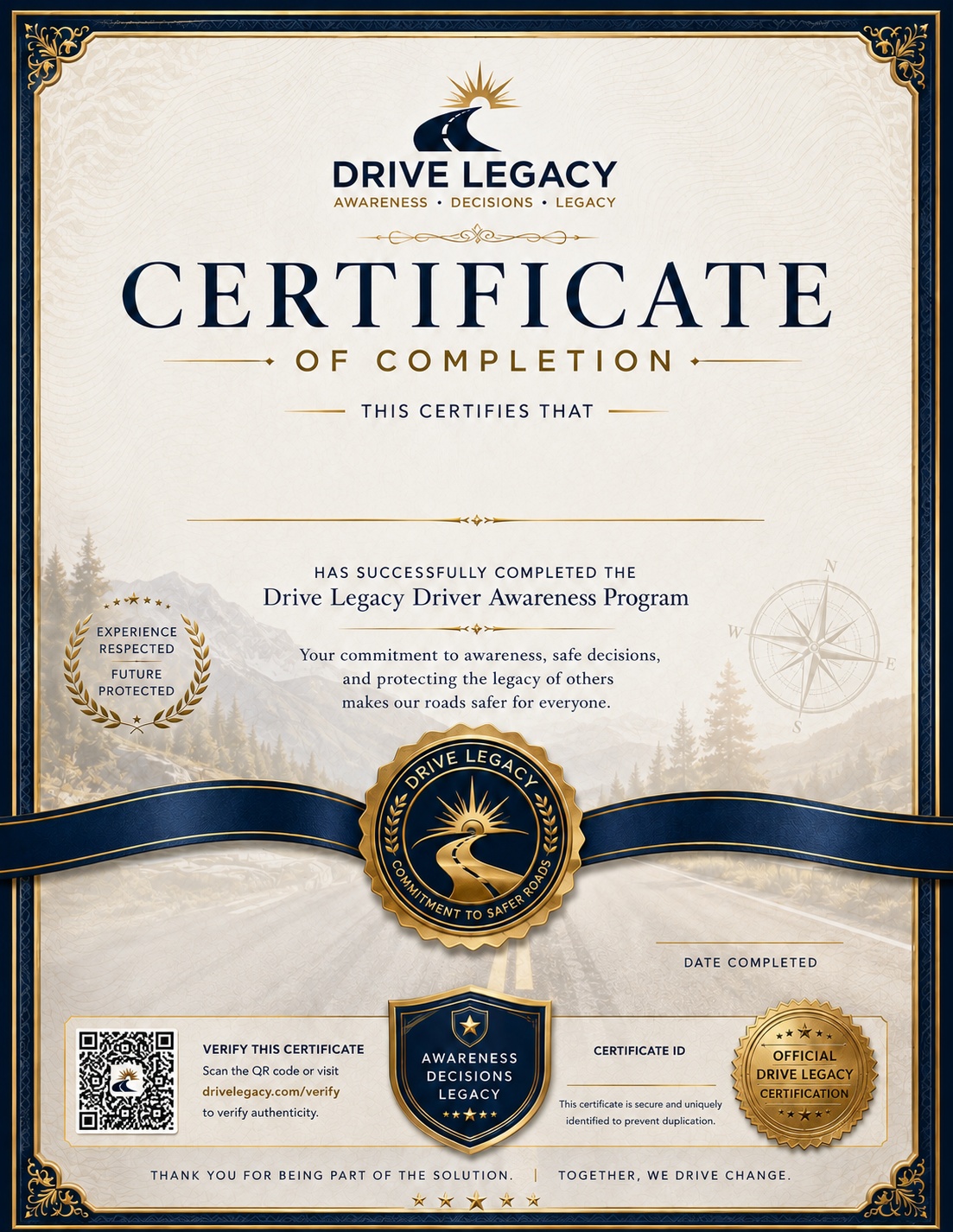
The certificate recognizes a teen driver’s commitment to additional preparation, awareness, and safer decision-making. It is not a replacement for state licensing, driver education, or supervised road practice.
It represents something meaningful: the willingness to do more before facing more.
Help the next generation build safer habits before experience has to teach the lesson.
Ask About Teen Driver ProgramsCall (321) 252-8611